
Indoor Air Quality Assessment
in Oklahoma City
Investigate the Air. Identify Contributing Conditions. Support Informed Decisions.
A Pioneer Environmental Indoor Air Quality (IAQ) Assessment evaluates indoor environments for airborne particulates, moisture-related conditions, and other factors that may influence indoor environmental quality. Assessments are based on observed conditions, building science principles, and targeted sampling where warranted.
Concerned about air quality, odors, or unexplained indoor conditions?

Independent Verification - Not Remediation Work
We do not perform mold remediation. We provide independent indoor air quality assessments, environmental sampling, and condition-based interpretation to help identify potential contributors to indoor air quality concerns.

What’s Included in a Professional Indoor Air Quality Assessment
An indoor air quality assessment includes a structured evaluation of airborne conditions within the areas evaluated. The process may include visual assessment, humidity and temperature measurements, particulate monitoring, HVAC and airflow evaluation, and targeted air sampling when warranted to help characterize indoor air quality conditions and support informed decision-making.


Detailed Visual Inspection
Moisture Mapping & Infrared Screening
Targeted Air & Surface Sampling
Laboratory Analysis & Findings Interpretation
Condition Documentation & Next-Step Guidance
Detailed evaluation of interior environmental conditions, including visible dust accumulation, staining, material condition, and other observable indicators that may reflect moisture intrusion, elevated humidity, ventilation deficiencies, or environmental imbalance. This process helps identify developing or active concerns within the indoor environment while providing critical context for the overall assessment and any additional data collected.
Assessment of moisture-related building conditions using non-invasive methods to help identify active or historical moisture issues that may be contributing to indoor air quality concerns. This process helps evaluate whether interior materials and surrounding conditions show signs consistent with prior water intrusion, humidity-related impact, or other moisture influences that may affect indoor environmental quality and warrant further consideration within the overall assessment.
Spore trap air sampling and surface sampling performed when conditions warrant laboratory confirmation, fungal identification, comparison of indoor and outdoor conditions, or additional documentation of suspect mold contamination.
Laboratory results interpreted within context of site observations, moisture conditions, building science, and accepted industry methodology to help determine whether the environment reflects normal fungal ecology, settled spores, or active fungal amplification.
Detailed reporting of affected materials, environmental conditions, and observed deficiencies, together with practical next-step guidance for remediation, source correction, cleaning, or additional evaluation where needed.
Why Indoor Air Quality Assessments Matter

Identifies Environmental Contributors
Supports Health-Conscious Decisions
Reveals Hidden Moisture Issues
Establishes Baseline Conditions
When to Schedule IAQ Assessment
Assessment helps determine whether environmental factors may be contributing.
Air quality concerns may be associated with ventilation, particulates, or other indoor sources.

Helps determine whether conditions such as moisture, ventilation issues, or particulate accumulation may be impacting indoor air quality.
Provides environmental context to support informed decisions regarding living or working environments.
Identifies conditions conducive to microbial growth that may not yet be visibly apparent.
Creates a documented snapshot of indoor environmental conditions at the time of assessment.

What’s Included in a Mold Assessment?
A mold assessment includes a structured evaluation of visible conditions, moisture-related building material impact, environmental conditions, and fungal concerns within the areas evaluated. The process may include visual inspection, moisture and infrared investigation, and targeted environmental sampling when warranted to help characterize indoor conditions and support informed decision-making.
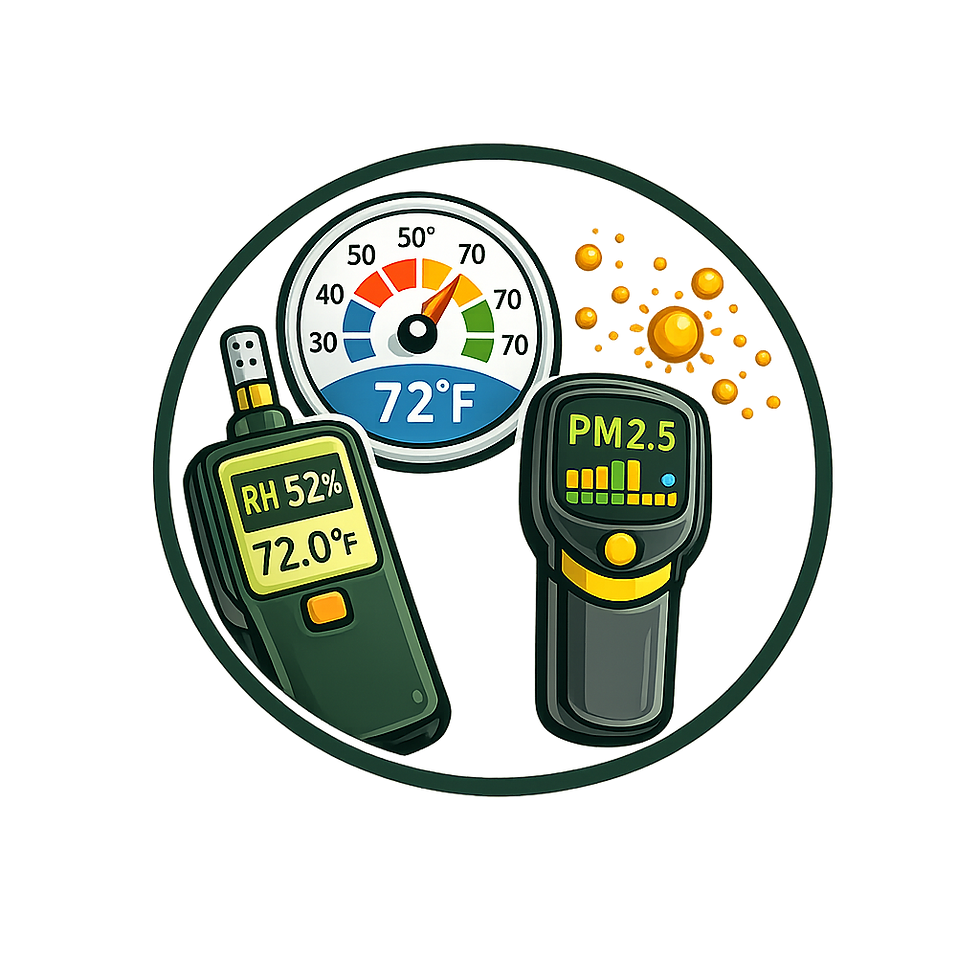
Atmospheric Conditions & Particle Counting
Evaluation of interior atmospheric conditions and airborne particulate levels to further characterize overall indoor environmental quality at the time of inspection. This process includes the measurement of temperature, relative humidity, dew point, and wet bulb conditions, together with real-time particle counting in the PM2.5 and PM10.0 size ranges. These data help identify environmental imbalance, elevated particulate burden, and humidity.
Visible dust buildup, poor airflow, or HVAC concerns are observed
Including supply vents, return pathways, filtration issues, or uneven airflow conditions.
Indoor air quality concerns or unexplained discomfort are reported
Persistent odors, stale air, or indoor stuffiness are present
Real estate transactions or due diligence require evaluation
Independent documentation supports more informed property decisions.
Recent renovation, construction, or occupancy changes occurred
Material changes, dust disturbance, or altered ventilation may affect indoor air quality.
You want clarity before making corrective indoor air quality decisions
Avoid unnecessary work and better understand the conditions present.
An indoor air quality assessment includes a structured evaluation of airborne conditions within the areas evaluated. The process may include visual assessment, humidity and temperature measurements, particulate monitoring, HVAC and airflow evaluation, and targeted air sampling when warranted to help characterize indoor air quality conditions and support informed decision-making.
What’s Included in a Professional Indoor Air Quality Assessment

Independent - Science Based - Project Focused - Defensible
Professional Indoor Environmental Assessments Based on Observed Conditions
& Industry Standards


Understand What’s in Your Indoor Environment

Make informed decisions based on clear, objective environmental data.
405-463-3463
pioneer-enviro.com
